

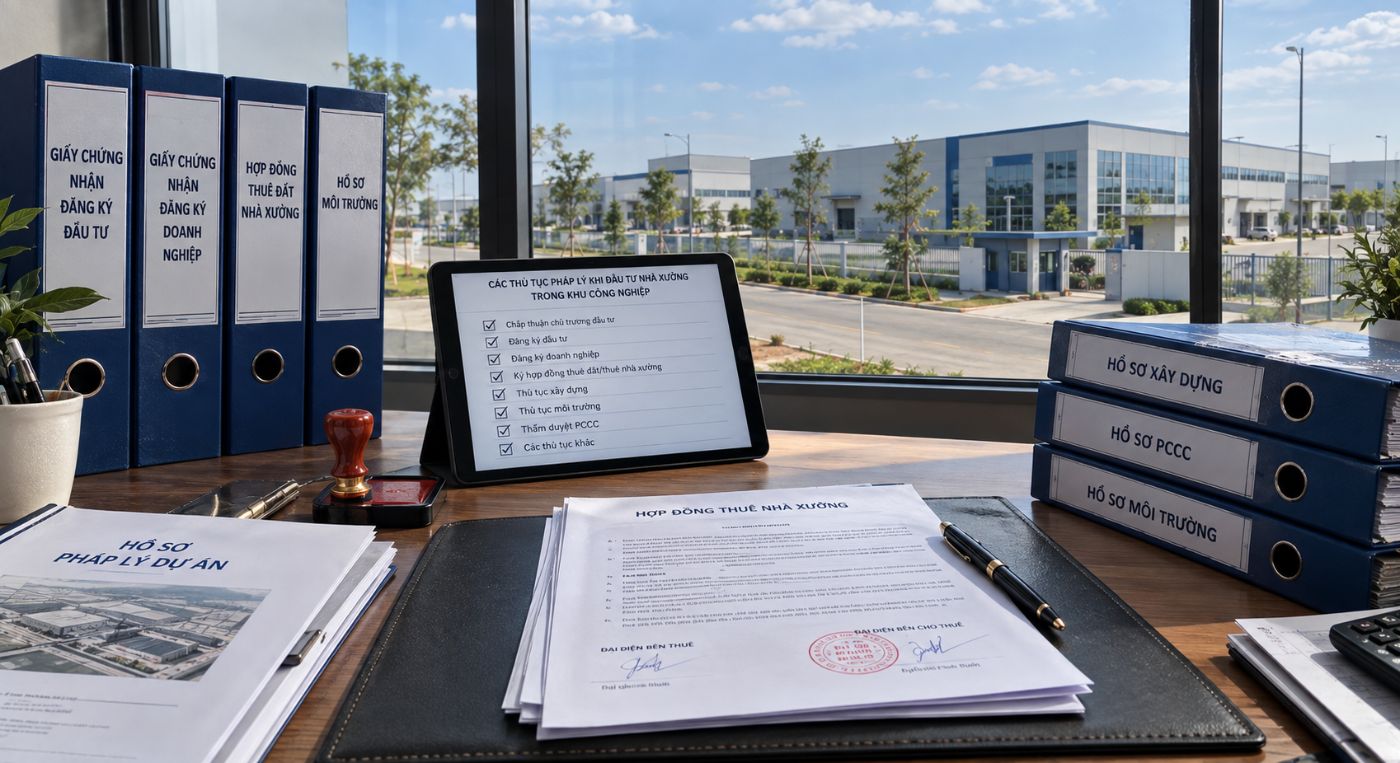
Permits Required Before Operating a Factory in 2026
2026 guide: permits required before operating a factory in southern industrial zones
Before a production line can officially start in an industrial zone, a business must complete a series of legal procedures — from investment registration, construction and fire safety to environment and labour. 2026 brings several important changes to these regulations.
Below is an updated list based on current law.
1. Investment Registration Certificate (IRC) and enterprise registration
This is the first step for investors, especially foreign-invested companies. The Investment Registration Certificate (IRC) is issued by the Industrial Zones Management Board or the provincial investment authority, confirming the project, business lines, capital and location.
After obtaining the IRC, the company applies for an Enterprise Registration Certificate (ERC) to formally establish a legal entity in Vietnam.
2. Construction permit
Under the 2025 Construction Law (effective 1 January 2026), certain grade IV works and small individual houses are exempt from construction permits if they are not in specific functional planning areas. However, this exemption mainly applies to small civil works; production factories in industrial zones — usually above the exemption threshold — in principle still require a construction permit in line with the approved detailed plan of the industrial zone, unless a specific local exemption applies. Businesses should check with the management board of the industrial zone where the project is located.
For ready-built factories whose construction procedures and acceptance were completed by the developer before leasing, tenants usually do not need to repeat this procedure — unless they plan renovations or additional structures.
3. Fire safety design approval and acceptance
This group of procedures changes significantly in 2026. Under Resolution 66.18/2026/NQ-CP (effective from 1 July 2026 to 28 February 2027), for works that already have a fire safety design approval certificate from the police but have not yet had their acceptance results approved, the "fire safety acceptance" procedure and the "inspection of fire safety acceptance" procedure are abolished. This is part of the roadmap to cut administrative procedures under the 2024 Law on Fire Prevention, Fire Fighting and Rescue and Decree 105/2025/NĐ-CP.
Even so, the initial fire safety design approval — confirming that the design meets standards on safety distances, escape routes and automatic fire alarm and suppression systems — remains mandatory before construction. Businesses should note that the rules are in a transition period and may be adjusted again after February 2027.
4. Environmental permit
Under Decree 48/2026/NĐ-CP (effective 29 January 2026) amending environmental protection rules, factories in the list of activities that may affect the environment must carry out an environmental impact assessment (EIA) before construction, then obtain an environmental permit before official operation. Authorities are also consulting on merging the EIA and the environmental permit into a single procedure to reduce layers of paperwork while increasing companies' post-inspection responsibility. For large projects, the environmental permit may be issued in phases in line with the plant's actual investment schedule.
5. Work permits for foreign experts and workers
Companies employing foreign experts, engineers or managers at the factory must obtain work permits under current rules, except for cases on the exemption list (for example, experts working for less than a certain period under bilateral agreements, or certain specific positions under the new 2026 rules). The application includes a criminal record certificate, health certificate, proof of qualifications and a previously approved document on the demand for foreign workers.
6. Other documents and procedures
- Registration of internal labour rules with the provincial labour authority when the company has 10 or more employees.
- Registration for social insurance, health insurance and unemployment insurance for employees.
- Occupational safety permits for machinery and equipment with strict safety requirements (boilers, lifting equipment, pressure systems, etc.).
- Depending on the specific industry, additional sector permits may be required (for example, a wastewater discharge permit or a certificate of eligibility for certain conditional sectors).
Why legal procedures matter when choosing a factory model
Given the permits above, the time needed to complete legal procedures — especially construction and fire safety — often takes up a significant part of the total time before a plant can officially operate. This is why many investors prefer ready-built factories that have already passed construction and fire safety acceptance, which considerably shortens the procedures the tenant has to handle.
Note: This article is a general summary for reference based on the law in force at the time of publication. Rules on construction, fire safety, environment and labour may continue to change; businesses should check the original legal texts and consult a specialised legal adviser for each project.
Vina Factory supports permit applications for businesses leasing factories at Dong Ha Industrial Cluster. See the list of available factories and rental prices at Dong Ha Industrial Cluster.
Để lại một bình luận
Email của bạn sẽ không được hiển thị công khai. Các trường bắt buộc được đánh dấu *